
Q&A with Author Michael Gibney
www.thebrotherhoodandtheshield.com
What inspired you to begin writing?
I honestly don’t have a particular ‘idol’ or favourite author as such. I believe it was my overactive imagination that got me started. I visualise characters and storylines very vividly. It must be a childhood thing I never really grew out of I guess.
Where did you grow up?
I grew up in Belfast, Northern Ireland which in ways has its advantages and disadvantages. Growing up was hard as I came from a typical Northern Irish working class family. Religion was a big problem when I was growing up with troubles and terrorism. You couldn’t hang around kids from the opposite religion, even if you wanted to so my childhood was very lonely. The schools in Northern Ireland were very drab and bleak and you were never encouraged to have a dream or reach for something out of the ordinary. People in Northern Ireland when I was growing up had this mentality of ‘that’s your lot’ really. You work but there is very little else but work and go partying or play snooker or watch the soap operas on television. In the height of Margaret Thatcher, I suppose that’s all one could do. But for children we had to make our own amusement by finding rivers and dames and building little swings and going to the park to play games. It was harder for me as when I was in my teenage years I needed more stimulation like travelling, seeing something new. I had a thirst for life and to think big which was discouraged by my teachers in high school. The academics and the constructional education was encouraged as well as sports, subjects that had very little if any creative outlet in them at all and if one expressed such imagination or big ‘impossible’ dreams were considered foolish and most likely made an example of. It was a hard time but Northern Ireland has changed dramatically and its social mentality is more encouraging and creative. I spent most of my late teens and early twenties travelling when I could, which has given me the mental stimulation I needed to write this story.
Has your background had any effect on your writing?
Oh definitely. It is why the story is very European in a sense but my characters are mixed. Maybe even with a little bit of Irish myth in there, you never know until you read. As I am a Belfast born and raised lad I have been surrounded by a socially uncreative society built on rules and regulations. It would be grey if I could paint it a colour basically. So mentally I rebelled against the blandness of my countries industrial boom by the book. In a way Belfast’s culture both good and bad has helped with the realism of the books. Also C.S. Lewis was from Belfast too, which is something us Northern Irish are very proud of. I’m a big fan of his work and his work has influenced me to do more with my life and stimulate my individual imagination.
Where you always interested in writing for Children?
No. But I have always found the fantasy genre really intriguing. It was more to do with the visual aspects again and how there are limitless boundaries in the fantasy realm than in any other work of fiction. I believe this first volume of The Brotherhood and the Shield series is aimed at adults as well as children.
What is The Brotherhood and the Shield?
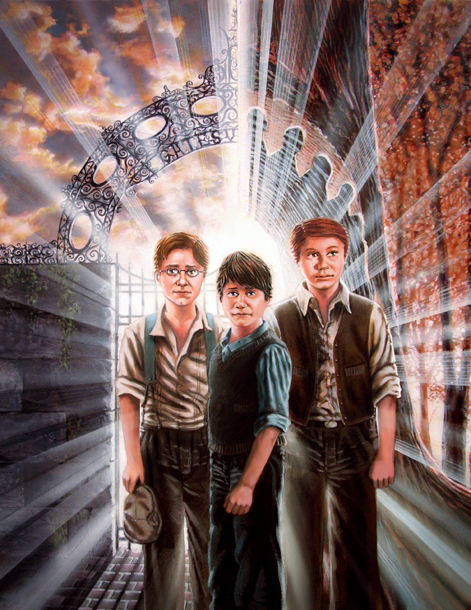
Without giving too much away, The Brotherhood and the Shield tells the story of a group of orphans growing up in a borstal home at the turn of the 20th Century in London. The series centres around three orphans (Benjamin Brannon, Sebastian Cain and Tommy Joel) and their progression from childhood to adulthood and the dramatic changes in each of their personalities towards themselves and each other. In The Three Thorns the orphans struggle surviving in tough upbringings in the real world before forces call upon them from a world beyond our own. The fantasy kingdom of Abasin that they discover has been overrun by a false king that has ruined most of what was good and magical about it. They are landed with the burden to put things right because of their birthright with the help of many of the world’s last survivors, most of them magical creatures. Through their journey to rid this world from evil the orphans meet, friends and foes, protectors and assassins set out to protect and train them into warriors or to hunt them down and kill them. But there are many twists in the story and much deceit about whom and what is evil and good. It has strong morals and dramatic realistic undertones some that cover the abuse of guardianship and power, corruption of aristocracy and the decisions under circumstances that shape and determine ones destiny. It is a road of discovery and bravery, a tale of sacrifice, loss and a message of battling all the odds. I can say for sure that not all things are what they appear to be in The Brotherhood and the Shield.
Do you think The Brotherhood and the Shield Series is marketable for Children?
I believe my novels would appeal to any fan of the fantasy genre of all ages. I believe that Children are in ways smarter and sharper than adults, which is why I haven’t held back with my imagination. Children will grasp this concept more than some adults will, simply because their minds are wide open with an abundance of imagination and adults will benefit from the character’s relationships more than the action and spectacle side to the novels. So there’s something for everyone.
How does your material differ from the likes of other fantasy novels (e.g. The Chronicles of Narnia, The Lord of Rings Trilogy, Lemony Snicket’s, His Dark Materials Trilogy and Harry Potter)?
What makes The Brotherhood and the Shield story stand out is the realism. Half of the entire series falls in and out of the real world and combines the alternative with real life scenarios. The story is also very dark and serious and deals with more broken hearted characters than most books in its genre. It is filled with much tragedy and tragic characters which is where the realism of the story breaks that gap of standard fantasy writing.
Do you consider this book to be as good as or better than any of these famous fantasy titles?
I’ve never written to be ‘as good as’ or to better anything. I write to be as individual as possible. That is my goal. So I believe The Three Thorns is simply its own story. As long as it’s different and reaches someone, then I have done what I have set out to do.
Do you aspire to be the likes of such authors like JRR Tolkien, Roald Dahl, Philip Pullman, JK Rowling etc?
In someway, of course it would be amazing. I would like the story to reach people, in their imagination and hearts the way these authors had achieved with their stories. That would make it all worth my while. But as for style or format I would very much like to be as original as possible. I am who I am. They are who they are and each author is very different and amazingly talented in their own way and successful in their own right. When writing, it’s always been very important to me that I’m not in competition with any other writer or story. I believe when one becomes competitive, you loose focus of your own creation and therefore it becomes less and less individual because you are too busy looking at ones work and success rather than concentrating on your own material. To have something original, I tend to make things up in my mind without watching or viewing similar genres.
Do you have any particular influences for writing the novel?
Yes, but oddly they are from film directors and visual contemporary artists such as painters and photographers. Of course there are going to be influences from authors but my stories and characters have been created mostly through my love of the audio –visual and cinematography. Surrealism art has also played a big influence with my novel.
How did you come up with the idea and basis for The Three Thorns?
I was having a migraine at the time and was thinking of my friend who I talked to earlier that day about his late parents. I began thinking of my childhood and how fortunate I was, which led to thinking of others less fortunate, mainly lower working class. Then I began to think of how unfortunate some adults and children’s lives have been and I wanted to write something that they could relate to. You know something they could call their own, like I was writing specifically for them and wanted them to live out their own fantasies of escapism and revenge on the wrong doers in their life through this story. If I had to narrow it down, I initially based the identities of the main characters on my friend’s loss and growing up as an orphan.
Did you start out writing a children’s book or was it something that developed?
The whole subject of orphans narrowed this particular book’s material for a younger audience, but as I began to think ahead of the entire series the more it progressed into something else. It became both a children’s book of struggle and victory and an adult’s book of reflection and loss. It was a really dark concept from the beginning and at first had too much realism before I began writing for the readers who may have been through a similar upbringing as the main characters. I always knew it was going to be a fantasy in order for me to give them an enjoyable and satisfactory uplifting feeling.
How did you come up with the main characters?
The story is centred round three orphan’s Benjamin Brannon, Tommy Joel and Sebastian Cain who each come from very different backgrounds but have that one thing in common. Apart from being abandoned at birth, our three heroes of this story are also brothers that are reunited by their protector Ariel who is sent to their aid from another world called Abasin, which is their original birthplace. The brother’s do not realise early on that they are related and what’s more that their father was the King of their world before he was betrayed and killed by his brother, the false king Saul. The Three Thorns follows Benjamin, Tommy and Sebastian through their hardships in the real world to their ultimate test of leadership and courage in their original world of Abasin where they face lethal assassins sent to kill each brother before they have time to become great warriors that threaten their Uncle’s throne. From Cecil Baskin, who is a trainer of sorcery that teaches the boys how to use their individual powers to Jodo Kahln, a loyal servant to King Saul who sets out with a large army to kill the rest of the good creatures and humans of Abasin, The Brotherhood and The Shield is filled with mysterious and original characters.
All of my main character’s personalities have been based on real life people I have met, some of them famous but I won’t say who they are, ha, ha. The less central characters I created myself. I think that working class people are so complex and diverse, which is the best basis for a fictional character’s personality. One of my characters was based on my best friend before the character became more and more like me. A lot of my second book deals with one particular character that I believe most people will relate to. His initial character in The Three Thorns is that of a lovable heroic underdog but his character changes later in the story, which I based on my own struggle with life and my mistakes and decisions, which adult readers will be able to relate to.
What makes you think this book will be marketable?
The Brotherhood and the Shield will be hugely marketable due to the massive interest in the fantasy genre alone. But more than that, it is its story that will make this book marketable to a wider and more varied audience. It is the type of rare story that fans of the fantasy genre and of other fiction are crying out for. The story of struggle, misfortune, victory, success, greed, power, change and tragedy is the link that will make children/young adults and older readers all come together and relate to the novel.
For a 6 book series, did you have everything planned out from the beginning?
Not everything ha, ha. I knew the main concept of the trilogy in very basic terms but the complexity grew with the writing and having more and more ideas as the first book progressed. But nothing ever goes to plan when you set everything out step by step. I have learned that there are no rules to writing your own story. There are guidelines and formats you can follow and get help from, but ultimately the entire direction and every single place, character and situation is up to you. I also believe that for me it’s more exciting to go with whatever idea you’re fortunate enough to get or stumble across and keep adding to it, like a recipe for a cake or meal. Your mind is like the foundation or base and the ideas and inspirations are the ingredients.
What’s in store with the future books?

I do not want to spoil anything or give away too much. All I can say is that The Three Thorns was a great foundation for what is to come. I can promise that the second and third books are going to be a lot different than The Three Thorns in terms of writing, style and feel. Most of the main characters (Cassius Shark, Cecil Baskin, Ariel, Benjamin Brannon, Mr Jennings, Jodo Kahln, Sebastian Cain and Tommy Joel to name a few) will change greatly. Some get older and the personalities change drastically, some get into deathly situations and some have dark revelations to tell and to discover. The future installments will also introduce new characters and show new worlds. They will also be longer in length and become incresingly suspenseful. That’s all I want to reveal at this point.
Any specific challenges in the writing?
I’ve had some ups and downs with the writing. I started with the initial plan that The Brotherhood and the Shield story would be in two parts, but as the writing progressed so did the complexity and scale of the story. I realised the story couldn’t possibly be told within two books so I had to expand the length to allow for important character development as well as defining the fantasy world and its creatures. I believe changing The Brotherhood into a 6 book series gives the characters and overall storytelling better justice. My biggest challenge was to keep the structure and plot tight. I didn’t want the plot to weaken or lose any of its continuity. Also dialogue is very important and narrowing main characters down whilst creating a world full of them was one of the hardest things to do. I think my main goal was to make sure that this book catches the attention of the reader and pulls them into the characters and storyline. I wanted to make sure it flowed easily and interesting enough, all of which were pretty challenging. One of the biggest challenges in the writing was to be able to create a story that would cross over to both young and adult readers. When I write in relation to the child characters in my book, I am writing for the younger readers and I give them more respect in the language and terminologies that are used rather than patronise them. When I write subtle innuendos (some based on real life) and the adult characters in my book, I am writing to relate to the adult reader more so. That proved extremely difficult to master but I believe I managed to accomplish this.
How do the main characters differ from one another?
No person or in this case brother is alike in this book. You take Benjamin Brannon for instance, he is the most mature and wisest of the three but again he is very naive and in ways the most vulnerable due to his stature and emotional state. He is a very deep character that is inquisitive, good hearted and is very aware of what goes on around him. Tommy Joel is a headstrong bully to begin with and has a quick temper around authority and his peers. He’s the type of character that relies on his muscle rather than his brain. Although not the brightest, he is the most courageous and strongest out of the three brothers. Then there is the quiet shy Sebastian Cain who is very intelligent and has a natural talent for academics and science. He is the brain of the Brotherhood and in some ways a leader of the three. He is the peacemaker of the story with a great sense of following the rules. Each of these characters work well with each other and you get the sense that they are very like most brothers, there are disagreements and each share a different outlook in certain situations but all are loyal and protective of one another.
Who is the main Character of the three brothers?
The main character is actually Tommy Joel in the grander scale of the entire story that makes up the Brotherhood and the Shield series. But the reader could take it that the real story is centred round Benjamin Brannon which is the case with the third book ‘The Lost Prince’.

It really depends on the reader who they choose to be their individual hero. Some could identify with Sebastian Cain, even though the main focus is on all three brothers. It all depends on the individual.
Whom in the Brotherhood and the Shield do you most identify with?
Well, not the villains that’s for sure. Ha, ha. I identify with Benjamin Brannon as throughout the story Tommy and Sebastian have their own struggles with their Royal duty to fight and save their rightful kingdom and save the good of Abasin, whereas Benjamin’s fight is with himself and his constant state of his mind. That is why I feel more connected to his character as he deals with a lot of sadness and carries the biggest challenge of the three characters.
Where there any personal events that influenced your story?
The personal events of my friend’s past influenced the story and my desire to create a story for everyone basically. My political views on the world we live in today influenced me to write this story too and some may notice some heavy undertones in this story. My childhood memories helped also; the sense that I didn’t belong as part of my peers has had a major influence on these central characters. My strong disliking for schoolteachers and criteria and the lack of creativity or opportunity I had growing up as a creative person is a huge influence within The Three Thorns. This book was my escapism I want to share with others who feel just like I felt when I was growing up. I felt a lot of resentment and disappointment, which led to mistakes in life. These personal life experiences and reflections helped me mole Benjamin Brannon’s character, which may be a reflection of me or what I could have been. Yeah, it’s very deep.
What are your long term goals?
I would like this series to be given a shot by a major Publisher and Editor who is credible. I think the story will be a blessing to children and fans of the fantasy and sci-fi genre and I know it will be instantaneously successful with this massive fanbase of the genre. Currently I'm looking for a suitable Editor; someone really special, kind of like a bulldog of an Editor who knows what they are doing but more importantly, I want an Editor who believes in The Brotherhood and the Shield Series as much as I do. There is nothing like working with a team who believes in you. And that's the hardest part. It's not simply getting an agent. It's getting an Editor who believes in you and who treats you like family. I care about this series getting into the hands of Children all over the world. I want it out there. For an Editor to love the story and give it a shot means more to me than an advance. To me this is not a cliche. I'm being totally honest. The story will speak for itself.
My advice to author's would be, don't settle for anything or anyone less than what you feel your story deserves.
So if anyone out there feels they're the Brian Epstein of the Publishing World, hit me up!



No comments:
Post a Comment